
Home Cook Together. Celebrate Life.

FrenchAuthentic Cuisine

Croissant au Beurre

Serves 4 to 6 Pastry vegetarian, Breads & Pastry

Croissant au Beurre

In the bustling pâtisseries of Paris, the Croissant au Beurre stands as a morning staple, its flaky layers and buttery aroma drawing patrons like a gentle wake-up call. This home version captures the essence of those bakery-fresh delights, offering a slice of Parisian life that feels both indulgent and familiar. It's a daily ritual for many, a moment of pause in the everyday rhythm.

When done right, a Croissant au Beurre is a delicate balance of rich, buttery flavor and airy, crisp texture. The first bite should be a tender shatter of golden layers, yielding to a soft, pillowy interior. It’s the kind of pastry that pairs effortlessly with a café au lait, inviting a slow, unhurried start to the day.
Ingredients

  • 500 gall-purpose flour
  • 280 gcold butter — for laminating
  • 250 mlwhole milk
  • 10 gsalt
  • 20 gsugar
  • 10 ginstant yeast

Method

  1. In a large mixing bowl, combine 500 g all-purpose flour, 10 g salt, and 20 g sugar. Mix these dry ingredients thoroughly to ensure even distribution. In a separate bowl, dissolve 10 g instant yeast in 250 ml whole milk, which should be at room temperature to activate the yeast effectively. Once dissolved, create a well in the center of the dry ingredients and pour in the milk mixture. Stir until a rough dough forms, then knead on a lightly floured surface until smooth and elastic, about 5-7 minutes.
  2. Shape the dough into a ball and place it in a lightly greased bowl, covering it with a damp cloth. Allow it to rise in a warm, draft-free area until it doubles in size, which should take about 1-2 hours. This rising time allows the yeast to ferment, developing flavor and texture.
  3. While the dough is rising, prepare the butter block. Take 280 g of cold butter and place it between two sheets of parchment paper. Use a rolling pin to flatten it into a rectangle approximately 20 cm by 15 cm. The butter should be pliable but still cold, which is crucial for creating the croissant's flaky layers.
  4. Once the dough has risen, punch it down to release excess air and roll it out on a floured surface into a rectangle about 40 cm by 20 cm. Place the butter block in the center of the dough. Fold the dough over the butter, encasing it completely, and seal the edges by pressing them together.
  5. Begin the lamination process by rolling the dough into a long rectangle, approximately 60 cm by 20 cm. Fold the dough into thirds, like a letter, and rotate it 90 degrees. This is the first turn. Wrap the dough in plastic wrap and chill it in the refrigerator for 30 minutes to allow the gluten to relax and the butter to firm up.
  6. Repeat the rolling and folding process two more times, chilling the dough for 30 minutes between each turn. This creates the multiple layers that will puff up during baking. After the final turn, chill the dough for at least 1 hour, or overnight for better flavor development.
  7. Roll the chilled dough into a large rectangle, about 45 cm by 25 cm. Cut the dough into triangles with a base of about 10 cm. Starting from the base, roll each triangle tightly towards the tip to form the classic croissant shape. Place the croissants on a baking sheet lined with parchment paper, leaving space between each one for expansion.
  8. Allow the shaped croissants to proof at room temperature until they have doubled in size and are slightly jiggly to the touch, which should take about 1-2 hours. Preheat your oven to 200°C (392°F) during the last 20 minutes of proofing.
  9. Bake the croissants in the preheated oven for 15-20 minutes, or until they are golden brown and have a rich, buttery aroma. The layers should be visibly puffed and the exterior should be crisp to the touch.
  10. Once baked, transfer the croissants to a wire rack to cool slightly. Serve them warm to enjoy the contrast of the crisp exterior and the tender, buttery interior, which is the hallmark of a well-made Croissant au Beurre.
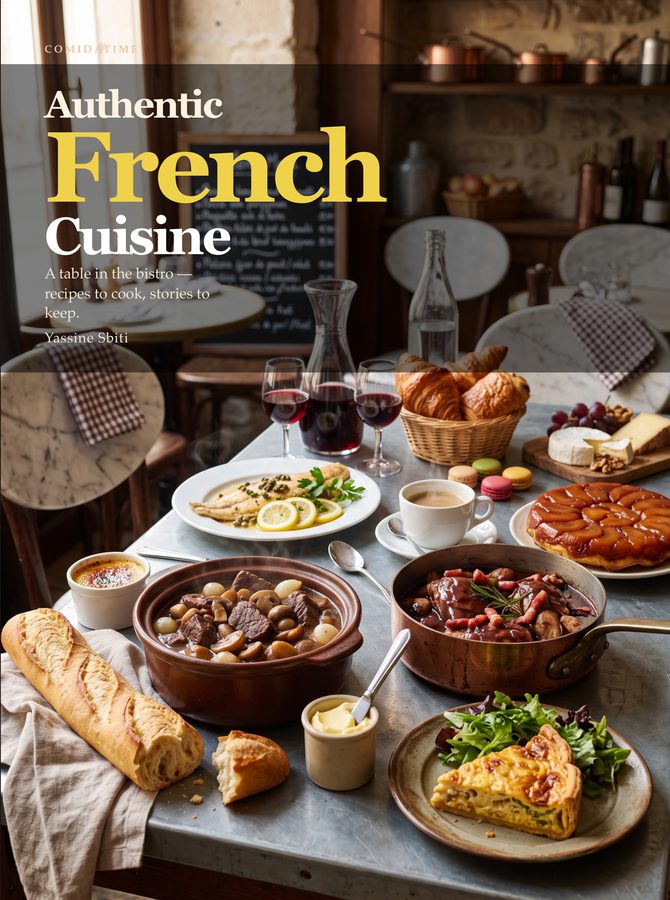
Cover of Authentic French Cuisine
From the cookbook

Authentic French Cuisine

This recipe is from Authentic French Cuisine by Yassine Sbiti — the French volume in the ComidaTime International Cuisines series.