
Home Cook Together. Celebrate Life.

SpanishAuthentic Cuisine

Pan Gallego de Hogaza

Serves 4 to 6 Bread vegetarian, Breads & Pastry

Pan Gallego de Hogaza

Pan Gallego de Hogaza is a staple in the homes of Galicia, Spain, where it is baked so frequently that the recipe is often committed to memory rather than paper. This rustic bread is known for its hearty texture and simple, yet satisfying flavor profile, reflecting the straightforward approach of Galician home cooking.

The bread combines strong bread flour and whole wheat flour, creating a robust loaf with a chewy crust and soft interior. The use of an active sourdough starter gives it a distinctive tang, while fine sea salt enhances its natural flavors. This bread is typically enjoyed as part of everyday meals, offering a taste of the Galician countryside in each slice.
Ingredients

  • 500 gstrong bread flour
  • 100 gwhole wheat flour
  • 450 mlwater
  • 120 gactive sourdough starter
  • 12 gfine sea salt

Method

  1. In a large mixing bowl, combine 500 g of strong bread flour and 100 g of whole wheat flour. Create a well in the center and pour in 450 ml of water and 120 g of active sourdough starter. Use your hands or a wooden spoon to mix until a shaggy dough forms. Sprinkle 12 g of fine sea salt over the dough and continue mixing until the salt is fully incorporated.
  2. Transfer the dough onto a lightly floured surface. Begin kneading by stretching and folding the dough repeatedly for about 10 minutes, until it becomes smooth and elastic. The dough should feel slightly tacky but not sticky. Form it into a ball.
  3. Place the dough back into the mixing bowl and cover it with a damp cloth or plastic wrap. Allow it to rise in a warm, draft-free area until it has doubled in size. This should take several hours, depending on the temperature of your kitchen. The dough is ready when it has a noticeable increase in volume and feels airy when gently pressed.
  4. Once risen, turn the dough out onto a lightly floured surface. Gently flatten it with your hands to release some of the gas. Shape the dough into a round loaf by folding the edges towards the center and then flipping it over, seam side down. Be gentle to maintain the airiness of the dough.
  5. Preheat your oven to 220°C (428°F) and place a baking stone or an inverted baking tray inside to heat up. Meanwhile, let the shaped loaf rest on a piece of parchment paper for about 30 minutes, covered with a cloth, to allow it to rise slightly again.
  6. Using a sharp knife or a bread lame, score the top of the loaf with a few slashes to allow it to expand properly while baking. Carefully transfer the loaf, along with the parchment paper, onto the preheated baking stone or tray.
  7. Bake the loaf in the preheated oven for about 30-40 minutes, or until the crust is a deep golden brown. The loaf should sound hollow when tapped on the bottom. If necessary, rotate the loaf halfway through baking for even coloring.
  8. Remove the bread from the oven and place it on a wire rack to cool completely. This allows the crumb to set fully. Once cooled, slice the bread and serve it with olive oil, fresh tomato, or enjoy it plain to appreciate its natural flavor.
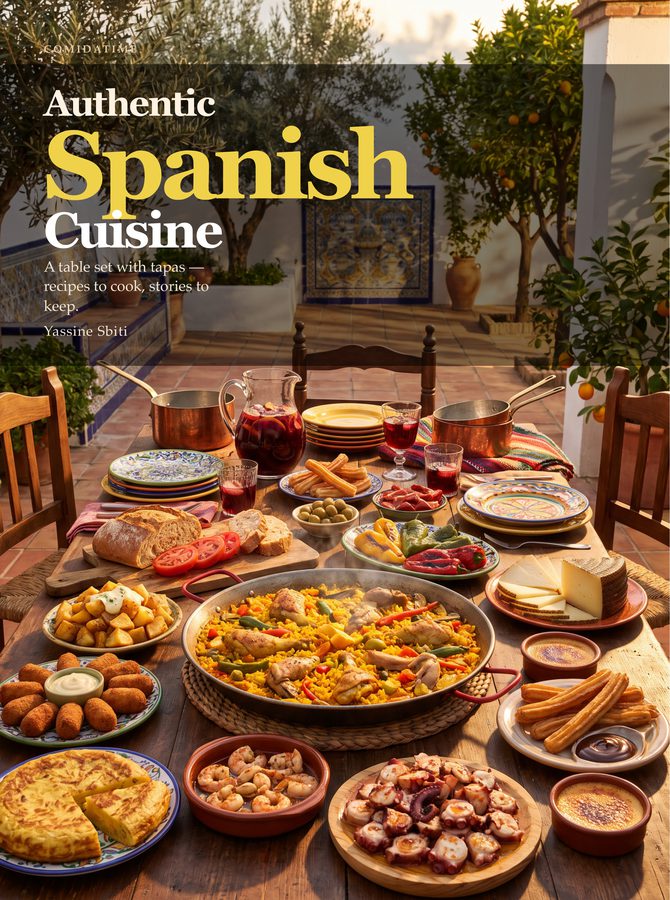
Cover of Authentic Spanish Cuisine
From the cookbook

Authentic Spanish Cuisine

This recipe is from Authentic Spanish Cuisine by Yassine Sbiti — the Spanish volume in the ComidaTime International Cuisines series.