
Home Cook Together. Celebrate Life.

SpanishAuthentic Cuisine

Empanada Gallega de Atún

Serves 4 to 6 Bread seafood, Breads & Pastry

Empanada Gallega de Atún

Empanada Gallega de Atún is a staple of Galician home cooking, where it graces tables frequently enough that recipes are scarcely needed. In Galicia, this savory pie is part of everyday life, a dish so familiar that its preparation becomes second nature. It embodies the rustic charm of the region, with each family adding its own touch to this beloved classic.

Cut through the crisp, golden crust to reveal a generous filling of tuna, sweet onions, and peppers, all lifted by the gentle smokiness of pimentón. The flavors meld harmoniously, offering a comforting taste of the sea and the land. Serve it warm or at room temperature, letting the simple, honest ingredients shine through each bite.
Ingredients

  • 500 gbread flour
  • 120 mlextra virgin olive oil
  • 180 mlwarm water
  • 7 ginstant yeast
  • 10 gfine sea salt
  • 3onions — thinly sliced
  • 2red bell peppers — cut into strips
  • 400 gcanned tuna in olive oil — drained
  • 2 tbsptomato sofrito
  • 1 tspsweet pimentón
  • 1egg — beaten, for the wash

Method

  1. In a large mixing bowl, combine 500 g of bread flour, 7 g of instant yeast, and 10 g of fine sea salt. Make a well in the center and pour in 120 ml of extra virgin olive oil and 180 ml of warm water. Mix the ingredients with your hands until a shaggy dough forms. Transfer the dough to a floured surface and knead it for about 10 minutes until it becomes smooth and elastic. Cover the dough with a damp cloth and let it rise in a warm place until it has doubled in size, which should be evident by its increased volume and airy texture.
  2. While the dough is rising, prepare the filling. Finely chop 3 onions and 2 red bell peppers. In a large skillet over medium heat, add a splash of olive oil and sauté the onions until they become translucent and soft. Add the red bell peppers and continue to cook until they are tender and the onions have taken on a slight golden color. Stir in 2 tbsp of tomato sofrito and 1 tsp of sweet pimentón, cooking until the mixture is fragrant and well combined.
  3. Drain 400 g of canned tuna in olive oil and add it to the skillet, breaking it up gently with a spoon. Mix the tuna with the vegetable mixture until everything is evenly distributed. Remove the skillet from the heat and let the filling cool to room temperature. This will ensure that the filling does not overheat the dough when assembling the empanada.
  4. Once the dough has risen, punch it down gently to release some of the gas. Divide the dough into two equal parts. Roll out one half on a floured surface into a rectangle about 3 mm thick, large enough to cover the base of your baking tray. Transfer the rolled dough to the tray, ensuring it covers the bottom completely. Spread the cooled tuna filling evenly over the dough, leaving a small border around the edges.
  5. Roll out the second half of the dough to the same thickness and dimensions as the first. Carefully place it over the filling, aligning the edges with the base layer. Pinch and fold the edges together to seal the empanada, ensuring no filling escapes during baking. Make a small hole in the center of the top dough layer to allow steam to escape.
  6. Beat 1 egg and brush it over the top of the empanada to give it a glossy finish once baked. Preheat your oven to 200°C (392°F) and place the empanada in the oven. Bake until the crust is a deep golden brown and the base sounds hollow when tapped, indicating it is fully cooked.
  7. Once baked, remove the empanada from the oven and let it cool on a wire rack. This allows the crumb to set properly, preventing it from becoming soggy. Once cooled, slice the empanada and serve it as is or with a drizzle of olive oil, highlighting the rich flavors of the filling.
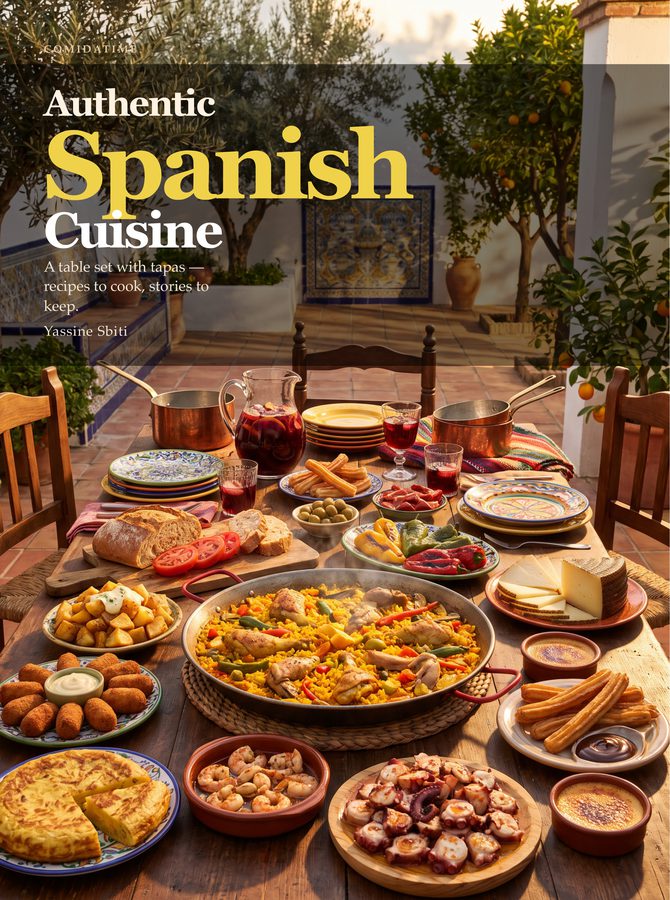
Cover of Authentic Spanish Cuisine
From the cookbook

Authentic Spanish Cuisine

This recipe is from Authentic Spanish Cuisine by Yassine Sbiti — the Spanish volume in the ComidaTime International Cuisines series.