
Home Cook Together. Celebrate Life.

PortugueseAuthentic Cuisine

Papo Seco

Serves 4 to 6 Bread vegetarian, Breads & Pastry

Papo Seco

Papo Seco, the quintessential Portuguese bread roll, is a staple at breakfast tables and snack times across Portugal. Traditionally baked in every local padaria, these rolls are a familiar sight in woven baskets, ready to accompany a hearty meal or to be enjoyed with a simple spread of butter and cheese. This recipe captures the essence of how it's made at home, with no shortcuts on quality ingredients.

Expect a crust that's satisfyingly crisp, giving way to a soft, airy crumb within. The olive oil imparts a subtle richness, while the sea salt balances the flavor profile perfectly. Each bite should be a reminder of why this bread is a beloved classic, celebrated for its simplicity and comforting taste.
Ingredients

  • 1 kgstrong bread flour
  • 20 gfresh yeast
  • 620 mlwater — at room temperature
  • 1 tspsugar
  • 2 tbspolive oil
  • 20 gfine sea salt

Method

  1. In a large mixing bowl, dissolve 20 g of fresh yeast and 1 teaspoon of sugar in 620 ml of lukewarm water. Stir gently until the yeast is fully dissolved and begins to froth slightly, indicating that it is active.
  2. Add 1 kg of strong bread flour and 20 g of fine sea salt to the yeast mixture. Pour in 2 tablespoons of olive oil. Using your hands or a sturdy wooden spoon, mix until a shaggy dough forms. Transfer the dough onto a lightly floured surface.
  3. Knead the dough by folding it over itself and pushing it away with the heel of your hand. Continue this process for about 10 minutes, until the dough is smooth and elastic. It should bounce back slightly when pressed with a finger.
  4. Place the kneaded dough back into the mixing bowl and cover it with a damp cloth. Let it rise in a warm, draft-free area until it has doubled in size. This should take about 1 to 2 hours, depending on the room temperature.
  5. Once risen, gently deflate the dough by pressing down with your hands. Divide it into 10 equal pieces. Shape each piece into a round ball by tucking the edges under, maintaining a light touch to preserve the air inside.
  6. Place the shaped dough balls onto a baking sheet lined with parchment paper. Cover them with a cloth and let them rise again for about 30 minutes, until they have puffed up noticeably.
  7. Preheat your oven to 220°C (428°F). Once the dough has risen, make a shallow cut across the top of each ball with a sharp knife. This will help the bread expand properly during baking.
  8. Bake the Papo Seco in the preheated oven for 15 to 20 minutes, or until the crust is a deep golden brown and the base sounds hollow when tapped. This indicates that the bread is fully baked.
  9. Remove the bread from the oven and transfer it to a wire rack to cool slightly. Allow the crumb to set for about 10 minutes before tearing into the rolls. Serve warm with olive oil, butter, or cheese.
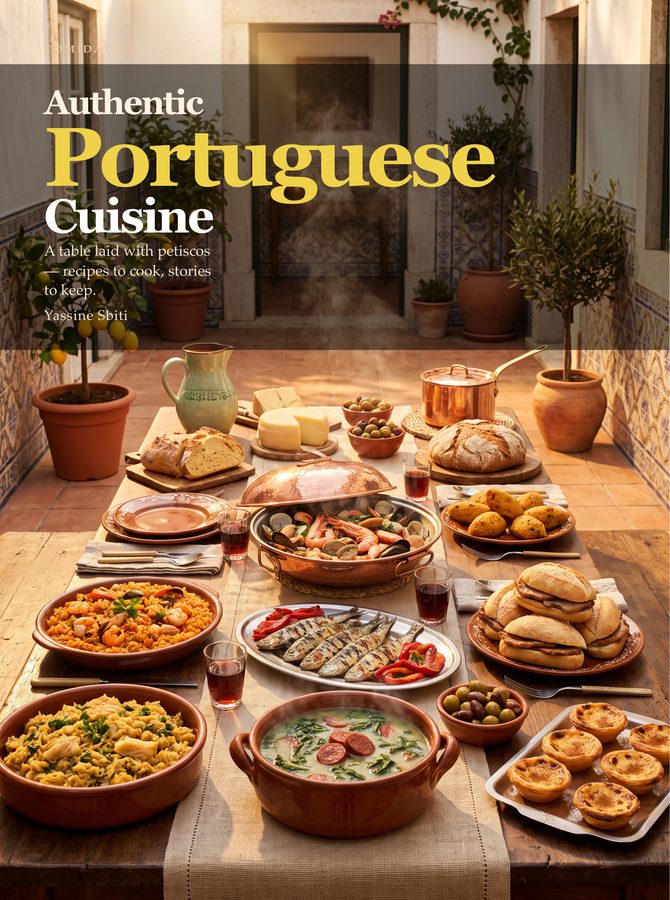
Cover of Authentic Portuguese Cuisine
From the cookbook

Authentic Portuguese Cuisine

This recipe is from Authentic Portuguese Cuisine by Yassine Sbiti — the Portuguese volume in the ComidaTime International Cuisines series.