
Home Cook Together. Celebrate Life.

SpanishAuthentic Cuisine

Tarta de Santiago

Serves 4 to 6 Dessert vegetarian, Desserts

Tarta de Santiago

Tarta de Santiago is a beloved staple in Galicia, Spain, with roots deep in the region's culinary tradition. Often prepared without a written guide, this cake finds its place on everyday tables, cherished by those who know its flavors by heart. Generous in portion and direct in its seasoning, it is as much a part of Galician life as the landscape itself.

Expect a moist, dense texture with the sweet richness of marcona almonds, complemented by the subtle brightness of lemon and warmth of cinnamon. Topped with a delicate dusting of confectioners' sugar in the shape of the Cross of Saint James, it is both visually and flavorfully satisfying.
Ingredients

  • 250 gground marcona almonds
  • 250 ggranulated sugar
  • 4eggs
  • 1lemon — zested
  • 1 tspground cinnamon
  • confectioners' sugarfor the Cross of Saint James

Method

  1. Begin by preheating your oven to 180°C (350°F) to ensure it reaches the right temperature by the time your batter is ready. Meanwhile, take 4 eggs out of the refrigerator and let them come to room temperature. This helps them mix more smoothly with the other ingredients, resulting in a more even texture for your tarta.
  2. In a large mixing bowl, combine 250 g of ground marcona almonds and 250 g of granulated sugar. Use a whisk to blend them thoroughly, ensuring there are no lumps in the sugar. This dry mixture forms the base of your batter, giving the tarta its characteristic nutty flavor.
  3. Zest one lemon directly into the almond-sugar mixture, taking care to only remove the yellow outer layer and avoid the bitter white pith. Add 1 teaspoon of ground cinnamon to the bowl. The lemon zest and cinnamon will infuse the batter with a subtle aromatic quality that complements the almonds.
  4. Crack the 4 room-temperature eggs into the bowl with the dry ingredients. Using a whisk or an electric mixer on low speed, blend the ingredients together until you achieve a smooth, homogeneous batter. The mixture should be thick but pourable, with no visible streaks of egg or dry ingredients.
  5. Grease a 23 cm (9-inch) springform pan with butter or line it with parchment paper to prevent sticking. Pour the batter into the prepared pan, using a spatula to spread it evenly. This ensures the tarta bakes uniformly, with a consistent texture throughout.
  6. Place the pan in the preheated oven and bake for 30 to 35 minutes, or until the top is golden brown and a skewer inserted into the center comes out clean. The tarta should have a firm, slightly springy texture, indicating it is fully baked.
  7. Once baked, remove the tarta from the oven and let it cool in the pan for about 10 minutes. Carefully release the springform and transfer the tarta to a wire rack to cool completely. This cooling period allows the flavors to meld and the texture to set.
  8. To finish, dust the top of the cooled tarta generously with confectioners' sugar. For a traditional presentation, use a stencil of the Cross of Saint James to create a decorative pattern. Serve the tarta at room temperature, allowing the delicate almond and citrus flavors to shine.
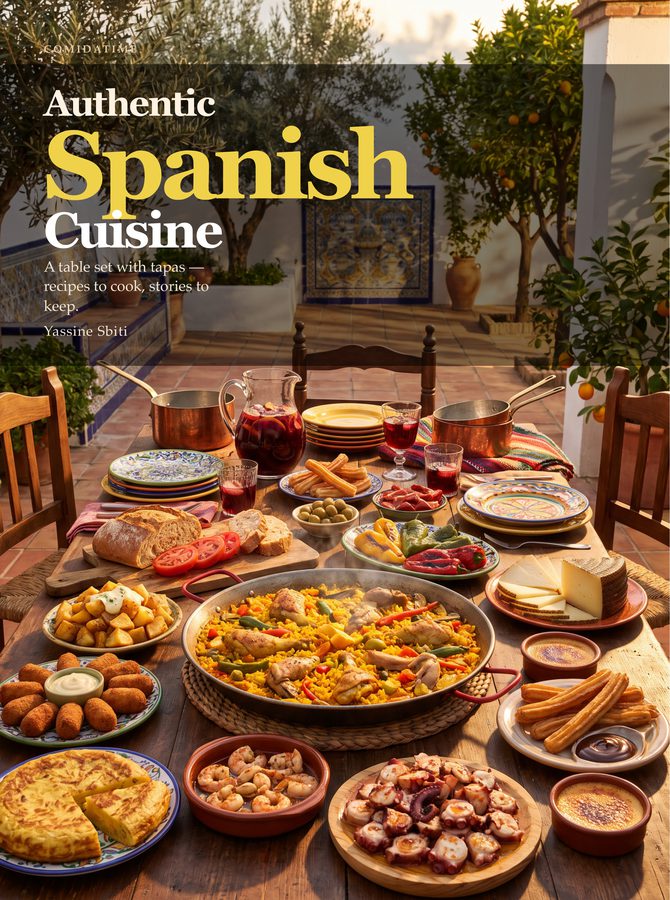
Cover of Authentic Spanish Cuisine
From the cookbook

Authentic Spanish Cuisine

This recipe is from Authentic Spanish Cuisine by Yassine Sbiti — the Spanish volume in the ComidaTime International Cuisines series.